
Pismo State Beach Foredune Restoration & Improvement Project
Restoring native dunes. Strengthening our coast. Advancing On-The-Ground Impact

At Pismo State Beach, California State Parks and the Coastal San Luis Resource Conservation District are leading a multi-year effort to restore and protect a vital stretch of coastal dune habitat. Supported by the California Department of Fish and Wildlife’s Environmental Enhancement Fund, this project spans approximately 151 acres and is now actively transitioning from planning into implementation.

Why the Dunes Matter
Coastal dunes are more than scenic landscapes, they are dynamic natural infrastructure. Native dune vegetation stabilizes sand, absorbs wave energy, and helps protect inland areas from erosion, flooding, and sea-level rise.
Over time, invasive species like ice plant, European beachgrass, and acacia have overtaken large portions of the dunes. These species form dense monocultures, disrupt natural sand movement, and reduce habitat quality for native plants and wildlife. Restoring these systems is essential to rebuilding both ecological health and coastal resilience.
Our Goals
Over the life of the project (through September 2029), we aim to:
- Reduce invasive plant cover across all restoration plots.
- Reestablish native dune habitats using locally collected, site-adapted seed to maintain genetic integrity. Key species include yellow and red sand verbenas, beach evening primrose, Indian paintbrush, and sand aster.
- Improve habitat quality and ecological resilience to benefit sensitive wildlife such as the Western monarch butterfly, the Northern California legless lizard, and rare plant species.
- Reinforce the protective function of foredunes so they can better absorb wave energy, reduce storm impacts, and adapt to rising seas.
Project Areas
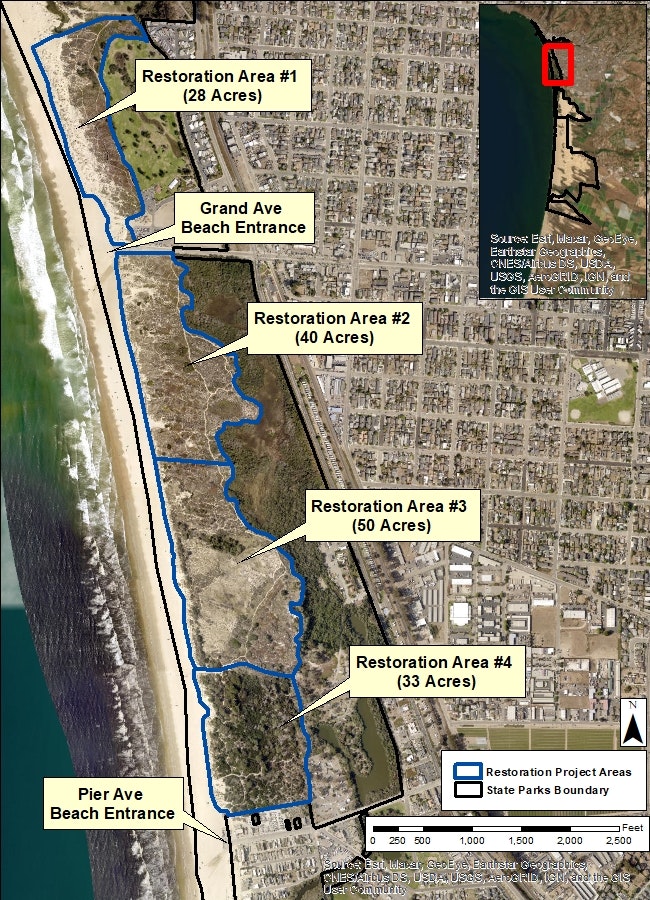
The site is divided into four major restoration areas, each with unique challenges:
- Area 1 (28 acres): Heavily dominated by ice plant with very limited native cover.
- Area 2 (40 acres): Mix of ice plant and beachgrass with scattered native lupine and Mock Heather.
- Area 3 (50 acres): Similar to Area 2 but with slightly more beachgrass and a few woody invasives.
- Area 4 (33 acres): Dense stands of golden wattle and non-native eucalyptus form a closed canopy that excludes native plants. Semi-natural stands of cypress, pine, and riparian species will be retained where appropriate.
Restoration Approach

With planning and environmental review complete, restoration efforts will move forward through a phased and adaptive approach across the project site. Work will begin with targeted removal of invasive plant species, prioritizing areas where dense vegetation is limiting natural dune movement and ecological function. These efforts will be implemented using best management practices to protect sensitive habitats, cultural resources, and wildlife, with timing adjusted to account for seasonal considerations such as nesting activity.
As invasive species are reduced, the project will transition into reestablishing native dune vegetation. Native plants will be propagated from locally collected, site-adapted seed to ensure long-term resilience and compatibility with the surrounding ecosystem. This approach supports the recovery of natural dune processes, allowing sand movement, vegetation patterns, and habitat structure to function more dynamically over time. Ongoing monitoring will guide implementation, allowing for adjustments and refinements to ensure restoration success as conditions evolve.
Community Connections
Because the dunes are a highly valued public landscape, community engagement will remain an integral part of the project. Visitors can expect to see interpretive signage installed at key access points, including the Grand Avenue boardwalk, providing information about dune ecology and restoration efforts.
Building a Resilient Shoreline
Through the restoration of native vegetation and natural dune dynamics, the Pismo State Beach Foredune Restoration & Improvement Project is designed to strengthen the coastline’s ability to adapt to changing conditions. By improving ecological function and supporting diverse habitats, the project contributes to long-term coastal resilience while preserving the natural character and ecological value of one of California’s most iconic beaches.
Funders: California Department of Fish and Wildlife’s Office of Spill Prevention and Response Environmental Enhancement Fund
RCD Contact: Samantha Alvarez, salvarez@coastalrcd.org